Thursday, October 22, 2015

Special Effect

The following pictures are from an episode of Vampire Diaries. Vampire Diaries includes a lot of scenes with fog to set the mood and the setting right before something traumatic is about to occur. The fog signifies that someone is going to come into the scene or that a spirit is among the character.
In this first scene, Elena is casually writing in her journal. The audience can see a little bit of fog coming from the left side of Elena, but she is oblivious to it. 
In this next clip, she has become aware of the fog and you can see the concern in her face.

Tsotsi- Sound & Music

Music did an interesting job of setting the tone for the different scenes in the movie. In the scene where Tsotsi ran out of the bar, there was fast paced music, which set the mood for him running away. Afterwards, when he is in the rain, quiet soft music came on. This supports the sad reflective moment he was having. He was reflecting on past memories as a child so this music went well with the scene.
Music gives more emotion to scenes for the audience. It helps the audience empathize with the characters because they can sense how the characters are feeling.

Sunday, October 11, 2015

Transition- The Fade

In the following scene of Grey's Anatomy, Grey is telling a story she recalled as a child. Throughout this entire scene there are several fade ins and fade outs to recall her memories through flashbacks. In the beginning a lit up candle fades into siren lights, and then her face appears as the lights fade out.


Throughout this clip, she continues telling the story from her childhood. However, the flashbacks are not of her as a child but of her memories she recalls with Derek. She's still telling the story of her childhood when she was on the carousel, even though the clips being shown are of her and Derek. This could be because she is explaining how memory is a funny thing in general, and the director is showing this connection by having these clips fade in and out of each other. Her story about the carousel is a representative of life, which is how this memory of her childhood is relative to her memories with Derek.
Historical Framework- The Whale Rider

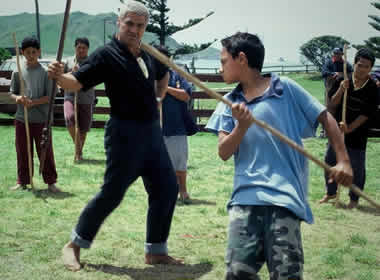
The Whale Rider shows many different aspects of the Maori culture throughout the movie. The characters in this movie were very respectful of the environment that surrounded them, which is a custom of the Maori people. They spent a lot of time outdoors during the majority of the movie. I also noticed that there was a lot of story telling being passed down. One of the customs this culture carries is the exchange of stories, which this movie did a good job portraying. In the presentation we learned that it is common for people to follow in their ancestors' footsteps. This was especially prevalent when Koro was teaching the boys about culture in hopes that they would carry these traditions with them and keep them alive.

In past times, the Maori people didn't see women as leaders, which is why Koro did not want Paikea to be apart of these lessons.

Another strong historical connection in this movie is that the Maori people believed that they came from the 'whale rider.' This was carried on throughout the movie and the Maori people were very concerned for the whales. The entire community attempted to help the whales when they were on land, and were all devastated when they could not succeed.


Monday, October 5, 2015

The Road Home- Symbolism

The Road Home used many different symbolic objects throughout the movie. One in specific that I paid special attention to was the bowl the main character, Di, carried throughout different scenes in this movie. The bowl was designed with intricate detail so it was easy to identify it. She used the bowl to serve Mr. Luo and the other workers food, with hopes that Mr. Luo would notice her and her food. When Mr. Luo came to her house, she served him using this bowl. When he left the village, she chased after him holding the same bowl. To me, this bowl symbolizes the strength of their love. When the bowl broke, Mr. Luo had left and him leaving was a test to see the strength of their love. When Di's mother got the bowl repaired, it seemed like Zhang had more hope in her love for Mr. Luo. Soon after, he returned. Also, the bowl's detail was painted in blue. In the Chinese culture, blue symbolizes immortality. This could be to symbolize that Di and Mr. Luo's love will live on forever.  


Monday, September 28, 2015

Camera Movement

I chose a scene from Grey's Anatomy to show the power camera movement has on gaining the audience's sympathy. In this scene, Derek is laying on a hospital bed and looking up at a little girl. The scene starts out with a close up on Derek's face, full of cuts, and you can hear doctors discussing his case. This close up tells the audience that Derek is listening in on what the doctor are saying. The camera then switches to the little girl, in a lower angle, so the camera is looking up at the girl but the audience can still see the top of Derek's head so it's more of a fuller view of the whole scene. The camera then zooms in again at Derek's face as if the camera is on the ceiling looking down, and then quickly the camera angle changes to looking up at the girl. However, this time it's as if the camera is on the floor looking up at the ceiling, which is the angle Derek is looking up at the girl at.


The movement of the camera shows the audience how Derek is viewing the girl in this scene, as if the audience is looking through Derek's eyes, which helps the audience empathize with Derek. The camera also shows how the girl views Derek, helping the audience empathize with the girl.

Wednesday, September 16, 2015

400 Blows- Visual Style

This movie did a great job depicting the setting of France through multiple extra long shots. These shots showed the town and were especially evident when capturing the outdoors. There were a few close up shots, which were used when two characters were in deep conversation. One scene in specific that included a close up shot was when the main character was having a conversation with his mom about secrets. The director wanted the audience to stay focused on what the characters were saying in this scene, and not be distracted by the background. 400 blows captured mainly long shots from what i noticed. There were multiple scenes in the classroom and the main character's home.


This screenshot shows a long shot of the main character working on his essay. This is an interesting shot because it shows one of the many long shots this movie had inside of the boy's home. In this shot, you can see the character's body language as he writes his essay which gives you a sense of his feelings about the essay without him having to necessarily say them.